Note: this is a post that originally appeared at my old blog and generated a reasonable amount of interest there, so I am posting it again here.
Google Earth and Google Maps are both wonderfully useful resources for archaeologists and people in allied disciplines. Google Earth in particular is a quite a powerful little program largely because of its simple, intuitive interface and the fact that it is free. But can students, researchers or academics use these images from a copyright perspective?
Google earth’s (GE) simplicity of use is a little deceiving. Although you would be hard pressed to carry out spatial analyses, you can effectively use GE to display and manage quite a diverse range of information. For example, with a little effort it is possible to display data from your GPS, spatial data from spreadsheets and tables, photographs, background images (such as topographic maps) and aerial photos. This can all be achieved at no cost using freely available and/or open source software options. All in all, you can create some decent, publication-quality maps within GE and export the result as a stand-alone image file.
Despite its usefulness though, I have not yet noticed GE images in academic publications. Until recently I thought that this was because of restrictions imposed by Google, a reasonable assumption because after all, large corporations do take the issue of copyright quite seriously.
However, Google are quite accepting of people using their images for a range of purposes and across different media. When you use their software or web applications you are required to do so in a manner consistent with their End User License Agreement (EULA) and terms of service which includes the concept of ‘fair use’. In the case of images, ‘fair use’ includes using in them in a non-commercial context and providing full attribution to Google and their content providers. In other words you must ensure that the copyright attribution text and Google logo are included in the image, in full, and are not obscured or dramatically reduced in any way. I have highlighted the relevant information in the image below.
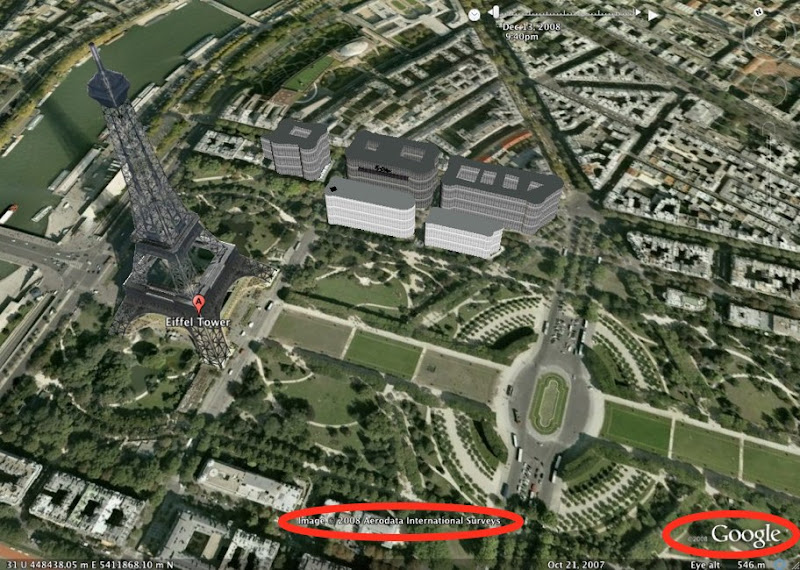
Google (or its licensors) retain the rights to an image (i.e. own the imagery) even when you remove that imagery from their products. If you follow their requirements for attribution then they suggest ‘fair use’ includes the following end uses for images exported from their applications:
- on a website by embeding some code or an actual image, as well as in streaming movies, webcasts, slideshows and so on. It is actually very simple to embed Google Maps products into your website using the steps at the Google latlong blog;
- broadcasting that image on a one-time use basis on television. You need to apply for special permission for use of their imagery where it will be broadcast an unlimited number of times, such as on TV or in a movie;
- print use, and in this respect they suggest :“you may use Google Maps and Google Earth content including photographic imagery in brochures, marketing collateral, packaging…newspapers, academic publications, journals and books”.
- Educational use including in “classroom, museum, research or academic (non-textbook) publication(s) provided you adhere to all terms of servce”.
This suggests that it is perfectly acceptable and legal to use Google Earth images in both modified and unmodified forms in, say, essays or reports written as part of your studies, academic theses, conference presentations, lectures, seminar presentations, academic journals and books. Consultancy reports may be a more complicated matter because they are fundamentally a commercial use of that image, and this would require special permission.
This is good news, particularly for people such as students who may not need or have access to more sophisticated and expensive GIS software. Furthermore, although Google Earth is quite useful out of the ‘box’, there are many sources of free data that would allow one to create impressive maps by adding overlays of contours, water courses, geology, vegetation and so on to your background Google Earth images. You can do this by searching for data layers that are in KML/KMZ format (google earth can read these), or you can convert existing GIS data (such as shapefiles) into one of these file formats.
Importantly, I should state that before using Google imagery products for any purpose you should read and understand the Google Maps/Earth Permission Guidelines as well as the relevent EULA, Terms of Use and Terms of Services documents for the product you are using. Links to these can be found below. It also goes without saying that this article definitely does not consititute legal advice.
As always, comments, tips or questions welcomed.
Links: Google Earth Google Maps Google Earth/Maps permission guidelines